The 'jusTT' Journey: Luke Abrahams on balancing career and world-class table tennis
As his skills sharpened, Abrahams began a decorated career of travelling and winning medals at both national and international levels.

South African table tennis player Luke Abrahams. Picture: Supplied
Luke Abrahams' remarkable table tennis journey recently took him to the prestigious 2026 ITTF World Team Table Tennis Championships Finals in London.
Competing at the iconic OVO Arena Wembley, the 37-year-old veteran experienced the pinnacle of the sport firsthand.
Alongside teammates Chetan Nathoo and Cuten Lodewyk, Abrahams faced a gruelling baptism of fire in the group stages against some of the world’s elite.
Despite the South African side’s immense fighting spirit, they exited the tournament following 3–0 defeats to both Saudi Arabia and Nigeria. Abrahams personally squared off against Saudi Arabia’s Abdulaziz Bu Shulaybi and Nigeria's Olajide Omotayo, encounters that highlighted the significant gap between local preparation and international professional standards.
“The atmosphere at the OVO Arena Wembley was incredible. The fans were fully engaged, and the intensity among players was extremely high. While it’s hard for me to train more than two days a week due to family responsibilities, a full-time corporate job, and running a business, the experience was still hugely motivating. I may not be able to match the volume of training of the world’s elite, but I focus on improving my technical and tactical quality within the time I have available.”
READ MORE:
The comeback of Theo Cogill: How a table tennis star overcame a stabbing to rule the courts
From ball picker to national champion: The resilient rise of Sthabile Mnyandu
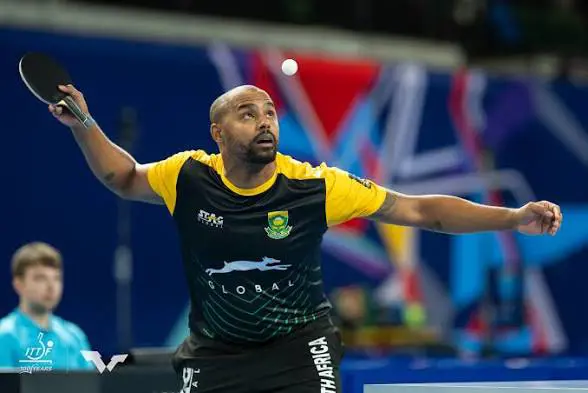
South African table tennis player Luke Abrahams. Picture: Supplied
The path to London began years ago in Johannesburg, sparked by a chance encounter that changed the trajectory of Abrahams’ life. He recalls seeing a group of children wearing provincial colours, which led him to their coach, Mr Gakiem Somadien. Somadien, who would later become Abrahams’ mathematics teacher, invited him to a training session that redefined his athletic focus.
At the time, Abrahams was a dual-sport talent, showing significant promise in volleyball, but the unique mental and physical demands of the table eventually won him over.
“At the time, I was also strong in volleyball and was on track to make provincial teams in both sports. Because the seasons overlapped, I had to choose one. Table tennis stood out because it challenged me in ways no other sport did, and I quickly realised I had a natural feel for the game. It helped build my confidence, kept me focused, and gave me a strong sense of belonging.”
As his skills sharpened, Abrahams began a decorated career of travelling and winning medals at both national and international levels.
However, his longevity in the sport is now fueled by a deeper purpose: ensuring the next generation has a smoother path to the podium than he did.
“Today, I continue to play and give back because I feel a responsibility to help create opportunities for the next generation and hopefully contribute to producing another international medallist for South Africa.”
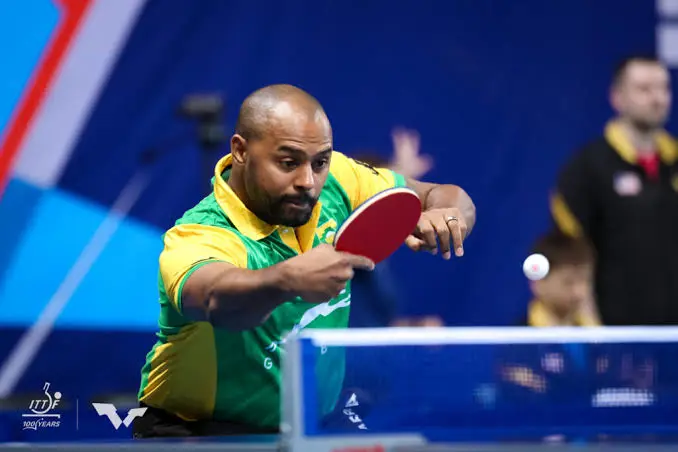
South African table tennis player Luke Abrahams. Picture: Supplied
Abrahams proved he still possesses the championship mettle required for high-stakes competition during the 2025 ITTF Africa South Regional Championships.
In a gruelling seven-set final against his perennial rival, Chetan Nathoo, Abrahams secured the Men's Singles title with a 4–3 victory. The match was a masterclass in psychological resilience, as he had to navigate a lapse in concentration after leading 3–1.
“Matches against Chetan are always tough, he’s a true competitor. I was leading 3–1 and could see the finish line, but a lapse in concentration allowed him back into the match. Going into the final set, I thought about the sacrifices I’ve made and the years my family has supported me, often with me being away from home. More than just wanting to win another match, I felt a deep sense of responsibility to make them proud. That mindset helped me regain focus, raise my level, and ultimately get over the line.”
Reflecting on the international "gap," Abrahams is candid about the missing ingredients in South African table tennis: infrastructure and exposure. While he operates the jusTT centre, one of the few local facilities with professional flooring and structured coaching, he maintains that a single hub is insufficient for national success.
“The biggest gap is the training environment and regular exposure to high-level competition. In South Africa, we currently have very limited professional training infrastructure. As far as I’m aware, my jusTT centre is one of the few facilities with proper flooring, equipment, and structured coaching support. Compared to Europe and Asia, where players compete in national leagues and weekly tournaments with prize money, our competitive exposure is limited to one major national event and a few regional tournaments. To reach world-class standards, we need multiple professional centres and consistent high-level competition — one centre alone isn’t enough to produce world-class players.”
To bridge this divide, Abrahams advocates for a dual approach: building robust local systems while simultaneously exporting top talent to more established global markets.
“If we are serious about competing internationally, we need to send promising young players to Europe or Asia to train and play in established leagues. That pathway can eventually open doors for more players while local competitions continue to develop. We need proper training hubs, structured national and local leagues, and tournaments with meaningful prize money. This would motivate players, attract new talent, and grow the sport sustainably across the country.”