SA economy bigger than estimated after rebasing - Stats SA
South Africa's economy is almost 5% larger than the previous estimate, Statistics SA found after a revision of GDP. The Money Show asks economist Johann Els whether the new figures have implications for the value of government debt.

Front loader trucks and other specialised machinery have been deployed on 20 February 2026 at a site in the Gugulethu Informal Settlement, Springs, where the illegal mining of gold was taking place. EWN/ Thabiso Goba
South Africa's economy is larger than previously estimated, says Statistics SA, following its rebasing and benchmarking of the Gross Domestic Product (GDP).
The 2026 process raised the level of the economy in 2022 to R6 990 billion, up by 4,9% from the previously published R6 667 billion.
Rebasing involves changing the reference year for constant-price estimates in national accounts.
As Stats SA explains, this has now been changed from 2015 to 2022. With a five-year frequency, the new base year would have been 2020; however, because this was not a normal year due to the COVID-19 pandemic, 2022 was chosen as it was relatively stable
The largest change in the 2026 rebasing exercise was shown in the mining industry - up by 12,5%.
This was because of the inclusion and better coverage of illegal mining, Stats SA says.
The second largest change occurred in finance, real estate and business services - up by 9,1%.
This was ascribed primarily to improved methodology for compiling owner-occupied housing estimates in real estate activities.
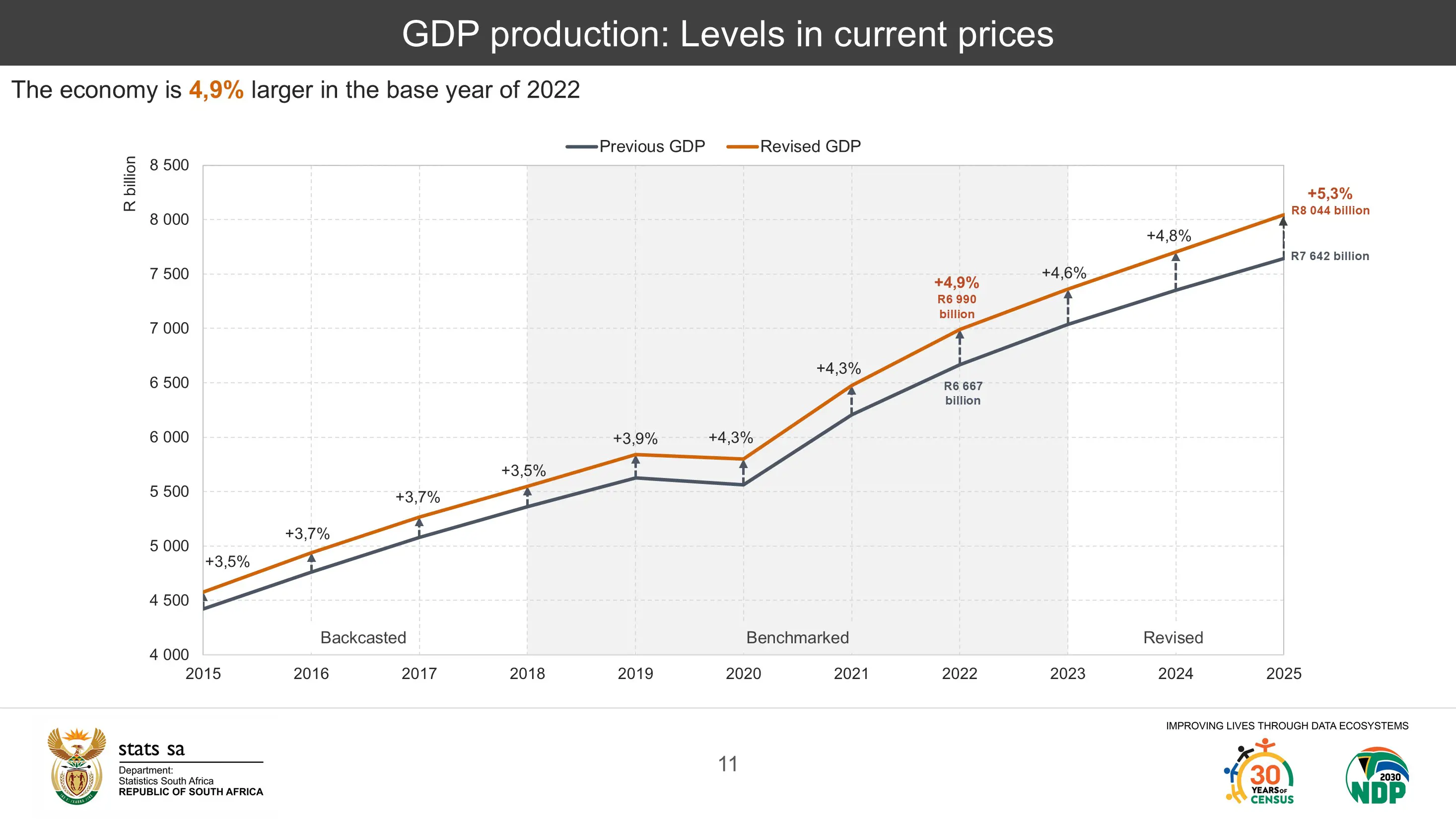
GDP rebasing shows SA's economy is larger than previously estimated - Stats SA (29 October 2026)
Stephen Grootes gets comment from Johann Els, chief economist at PSG Financial Services.
Now that we're using 2022 values to calculate the size of our economy, he asks whether this has any implications for the value of government debt.
Because the denominator of the equation is bigger also for debt versus GDP, government's debt ratio is actually now slightly lower, Els says.
This doesn't in essence change anything as the level of debt and the interest payments on it remain the same.
"We still need to redouble our efforts to get the economy going to get the debt down more substantially."
Els compares SA's debt ratio - now recalculated down to 74% from 78.2%, to that of a developed economy like the US, where the debt-to-GDP ratio is around 120% and rising.
"The US is not trying to do anything about it while we are at least trying to do something about our debt ratio."
Scroll up to the audio player to hear more insights from economist Johann Els