Reserve Bank hikes interest rate as fuel price shocks drive inflation
Sarb Governor Lesetja Kganyago announced the Monetary Policy Committee's latest repo rate decision on Wednesday.

SARB Governor Lesetja Kganyago delivers the MPC statement on 23 September 2026. Instagram/sareserve_bank
As expected by some analysts, the SA Reserve Bank (SARB) announced it has decided on a rate increase, in the face of the Middle East conflict and the oil price increase and inflationary fears it has led to.
Delivering the Monetary Policy Committee (MPC) statement, Governor Lesetja Kganyago said the benchmark repo rate would go up by 25 basis points, to 7.25%.
This means the prime lending rate now sits at 10.75%.
Members of the MPC were unanimous in their vote, concerned that global shocks continue to hurt the South African economy.
Kganyago noted that, since their last meeting, the Middle East conflict has escalated further, with little oil getting through the Strait of Hormuz.
At the same time, he said, oil exports from Saudi Arabia are being interrupted by fighting in Yemen and the Russia-Ukraine war is causing ongoing destruction of refinery capacity, and also affecting food exports through the Black Sea.
"These geopolitical events add up to a large, negative and persistent global supply shock, creating additional inflationary pressures. In this context, more central banks are raising rates... including the US Federal Reserve, which hiked last week for the first time in three years."
The Sarb Governor also noted that at the last meeting in July, they warned of downside risks to growth.
And the data has now shown that the economy contracted in the second quarter by 0.2%. However, the Sarb still expects a rebound during the second half of the year, with annual growth projected at 1.2%.
"We continue to project growth of around 2% over the medium term. This is based on global conditions stabilising, and domestic reforms delivering a better business environment. Our assessment is that growth risks are skewed to the downside."
When it comes to inflation, the Sarb has raised its near-term forecasts, mainly because of higher fuel prices.
"For example, petrol is rising again after moderating between June and August, with an average under-recovery of R2.83 per litre, currently. Headline inflation will likely be above 5% later this year and early next year, before slowing as the fuel shock recedes. We currently expect inflation to be back around 3% towards the end of 2027."
Ray White (in for Stephen Grootes) gets comment from Isaah Mhlanga, chief economist at Rand Merchant Bank (RMB).
Mhlanga says the Sarb outlook for inflation is actually lower than RMB's forecast, and they had expected a rate increase already at the July MPC meeting.
"We were expecting 25 basis points now; in fact we thought they should have hiked earlier because the inflationary expectations which the Sarb cares about had shown signs of deterioration, increasing to 4.4% for the current year and remaining above 4% over the next two years."
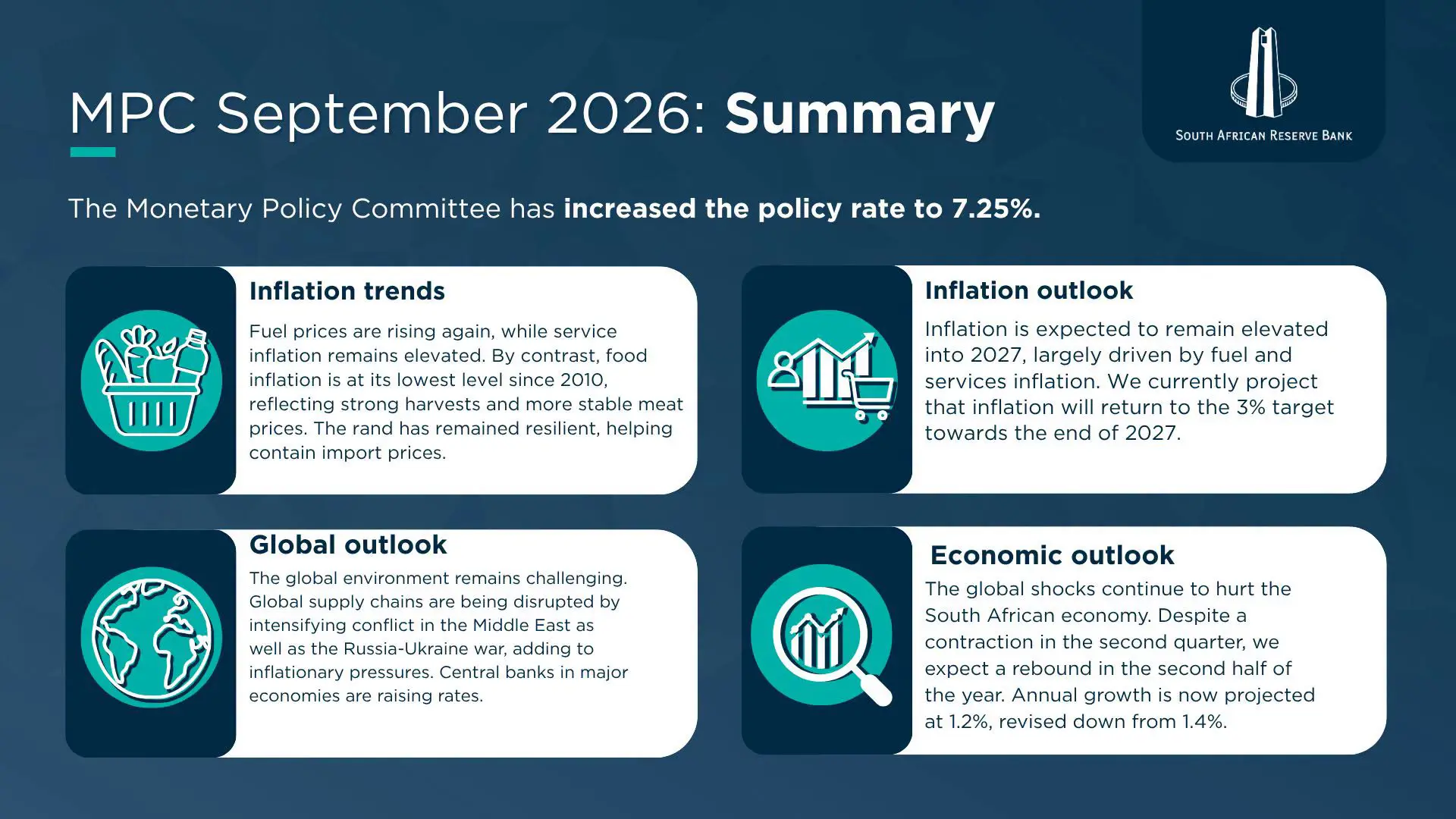
MPC September 2026 summary - SA Reserve Bank on Facebook
RMB expects two more consecutive increases in fuel prices going forward because the oil price is trending upward again after an earlier reversal.
"If you compare where the Sarb was at the July MPC and where they are in terms of their oil price forecast, they have raised this t by $8 per barrel to $90 for this year, $80 for next year, and then in 2028 they have $75 per barrel which is $5 higher than what they had."
"We think they will be disappointed because they are not filtering through the early risks that are coming that we think will eventually materialise."
Can we expect more rate hikes this year?
In view of the Middle East situation being the core issue, it has to be said that nobody knows when the conflict will end at this stage, Mhlanga says, possibly even the US authorities.
"As a result, it makes sense to assume that any sort of a reprieve or ceasefire is likely going to be short term and we will continue to see volatility in the oil price and therefore fuel prices."
The two local fuel price hikes they foresee, would lift inflation well above 5%, Mhlanga says.
With an inflation target of 3%, it is then reasonable to assume that the Reserve Bank will have to remain hawkish.
However, RMB believes the next rate hike is likely only in May of next year.
Scroll up to the audio player to listen to Mhlanga's analysis