'SAA has a future, everyone is getting paid' - senior airline exec
In a hard-hitting interview, Stephen Grootes grills Chief Corporate Affairs Officer Mphilo Dlamini about why South African Airways has been forced to stagger salary payments.
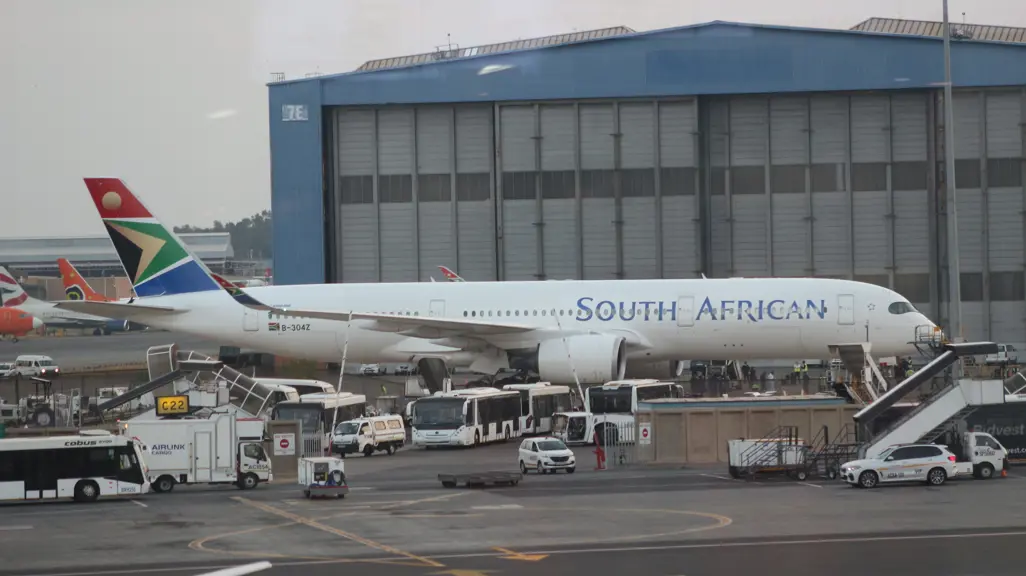
File image of South African Airways Airbus at OR Tambo, SAA. Wikimedia Commons/ Abeinspace
South African Airways is in the headlines over resorting to staggering salary payments for October, the second consecutive month it has done so.
On The Money Show, transport economist Joachim Vermoeten on Tuesday ascribed the airline's liquidity problems to, amongst others, expanding too fast after exiting business rescue and decision-making by top management.
RELATED: SAA's financial future in question again as airline resorts to staggering salary payments
In a follow-up interview, Grootes gives Mphilo Dlamini, SAA's Chief Corporate Affairs Officer, the opportunity to provide clarity on the perceived problems at the national carrier.
Dlamini insists that the situation SAA is in emanates mainly from the global aviation pressures he says all airlines are feeling, particularly as a result of the war in the Middle East and rocketing fuel prices.
"That has raised a lot of costs for us, especially jet fuel... And there were other issues - the constraint margins became even worse as a result of this. Also, running an airline in Africa is very expensive compared to other regions in the global aviation world; it's 17% higher in Africa than the global average."
When it comes to the decision to stagger salary payments in September and October, he talks about a trade-off being made after engagements with SAA staff, which started with their unions.
"It was to say: 'Colleagues, you want to keep the airline in the sky... We're going to focus on getting about 70% of our staff paid on time', which was the 27th of October. And then we said that management, pilots as well as board executives are the ones that will receive their salaries a day or two later."
Grootes puts it to the SAA exec that if this was caused by higher fuel prices, the two other big domestic airlines would have had to take the same decision about salaries, which they have not.
"It is because of the trade-offs, not necessarily because we didn't have money, as you're putting it. It is because we wanted to focus on the obligations that will keep us operating, like making sure we've got jet fuel so that the aeroplanes can fly."
Staggering salary payments is not the indicator that you are under pressure as an airline, is Dlamini's view.
He says other carriers may be busy with other trade-offs the public simply doesn't know about because "the scrutiny is always on SAA".
"We understand that because we are a state-owned entity, but I don't want to believe that it's only SAA that is feeling the pressure. All airlines are feeling the pressure - for example, one of the most successful in Africa, Kenya Airways, had to get over R4 billion from their shareholder."
When it comes to the R1 billion government guarantee that SAA received in August, Dlamini emphasizes that this cannot be seen as a cash injection or bailout.
"In this particular case, we did not go to government asking for a bailout. We requested the guarantee so that we can use it to go to any financial lender and make sure that we bring a bankable case and they're able to fund it at the back of the current guarantee. So, we do not get a financial direct injection from government as it has been portrayed."
Scroll up to the audio player to listen to the interview with SAA's Mphilo Dlamini