JAMIL F. KHAN | Poland’s giant Virgin Mary: The assertion of authority over a changing landscape
‘At a moment when religious authority is becoming less secure, we must ask why enormous wealth is being mobilised to make that authority physically gigantic,' writes Jamil F. Khan.
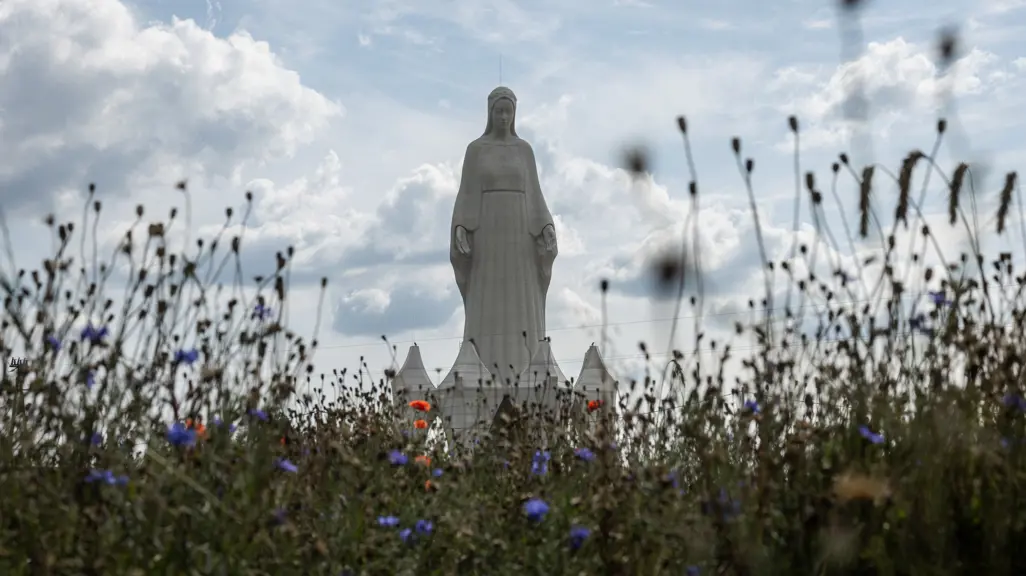
A statue of the Virgin Mary is seen over the field in Konotopie village, next to Torun, central Poland on 22 July 2026. Picture: AFP
The erection of a gigantic statue of the Virgin Mary in rural Poland is, on one level, an act of religious devotion. At 55.6 metres, the monument in Konotopie is now regarded as the tallest statue of Mary in Europe, rising above a village of fewer than 150 people. It was commissioned and financed by the wealthy industrialist Roman Karkosik and his wife, Grażyna, who have described it as an expression of gratitude to God. It was consecrated on 15 August, the Catholic feast of the Assumption of Mary, in a ceremony attended by hundreds of people, including former Polish president and Solidarity leader Lech Wałęsa.
But the monument is also an unusually revealing encounter between wealth, religious authority and masculine power. Its meaning cannot be reduced to the sincerity of the donors' faith. Religious monuments are never simply objects of belief. They are also interventions into public space: enormous declarations about what should be seen, what should be remembered and which institutions deserve authority. In this case, the extraordinary scale of the monument invites us to ask what happens when private wealth acquires the capacity to manufacture public religious symbolism on a monumental scale.
There is something almost perfectly contemporary about the project. A billionaire possesses the means to turn a private conviction into a landscape. Money becomes architecture; architecture becomes spectacle; spectacle becomes religious messaging. The individual who has accumulated enormous economic power can use that wealth to place a permanent representation of religious authority into the visual field of an entire community. The result is a curious fusion of philanthropy, piety and prestige. One person's capacity to spend becomes everyone's religious landmark.
The timing matters. The statue arrives at a moment when the institutional authority of the Catholic Church in Poland is under pressure. Poland remains deeply shaped by Catholicism, and the Church played an important role in the country's political history, particularly through its opposition to communism. Yet, religious affiliation and participation have been declining, especially among younger and urban Poles.
Against that decline, the monument can be understood as a kind of symbolic counter-offensive. When institutional authority becomes less secure, public symbols of authority can become more important. The enormous statue says: we are still here. We still occupy the landscape. We still possess the capacity to define the moral imagination of the nation. Mary may be presented as the object of devotion, but the monument also restores visibility to the institution and worldview surrounding her.
This is where the relationship between religious fundamentalism and wealth becomes particularly interesting. Fundamentalism often presents itself as a rejection of modern excess, moral decadence and materialism. Yet here religious devotion is expressed through extraordinary material excess. Religion becomes spectacular through capital.
There is a paradox at the heart of this relationship. Religious institutions may preach humility while welcoming enormous demonstrations of wealth. Billionaires can transform private fortunes into public sacred objects, receiving not merely admiration for their generosity but proximity to religious prestige. The rich patron becomes a builder of the sacred landscape. Wealth acquires moral legitimacy by attaching itself to God.
This is also why the statue invites a reading through masculinity. The monument is dedicated to a woman, but it takes the form of a gigantic vertical assertion of power. It is long, tall and erect, thrusting upwards into the sky. Its scale is inseparable from its message.
It does not merely represent Mary; it dominates the horizon.
There is something almost comic in the symbolism: a revered woman becomes the occasion for one of the most unmistakably phallic objects imaginable. The mother is made monumental through a form traditionally associated with masculine power, penetration, conquest and virility. Mary is elevated, but the elevation is accomplished through the visual grammar of the phallus.
This does not mean that the statue's creators consciously intended a sexual symbol. Nor does it diminish the sincerity of Marian devotion. Rather, it exposes something deeper about how societies represent power. Monumentality has historically been a language of masculine authority. Towers, obelisks, columns, rockets, skyscrapers and military monuments all use verticality to communicate dominance. To build something enormously tall is to announce that one has the power to make the world accommodate one's vision.
The billionaire donor, therefore, participates in a very old tradition: using architecture to make personal power permanent.
The statue becomes a public expression of private capacity, which is where the language of vanity becomes unavoidable. There is a particular form of billionaire vanity that seeks immortality through monuments. The accumulation of wealth creates the possibility of leaving something behind that is larger than the individual body. The monument becomes an extension of the donor's existence. Long after the billionaire is gone, the object remains, occupying land and horizon, directing people's attention upwards.
Religion provides an especially powerful vocabulary for this kind of immortality. A luxury building might testify to wealth. A religious monument can transform wealth into something approaching a sacred legacy. The irony is that the statue's invocation of feminine holiness simultaneously reproduces a distinctly masculine politics of public power. Mary is traditionally associated with motherhood, compassion, intercession and care. Yet the representation of these qualities is delivered through an object whose overwhelming physical presence communicates domination. The gentle mother becomes a colossal structure. The feminine sacred is made visible through an architecture of masculine magnitude.
This matters because symbols do not simply reflect society; they help organise it. A society populated by gigantic religious monuments is being asked to understand itself through religious authority. A landscape filled with enormous representations of saints, Christ or Mary makes religious identity physically unavoidable. It gives belief a scale that exceeds individual choice.
This may be particularly significant when belief is becoming less automatic. When fewer people inherit religious authority unquestioningly, institutions may increasingly need spectacle to sustain visibility. The enormous statue becomes a billboard for transcendence: an advertisement for a religious order whose cultural authority can no longer be taken for granted.
The monument is also expected to attract pilgrims and tourists, potentially transforming the local economy. Its viewing platform, pilgrimage ambitions and tourist infrastructure demonstrate how easily sacred symbolism enters the circuits of cultural consumption.
Religion becomes a destination, landmark, attraction and economic strategy simultaneously.
Its significance lies precisely in the collision of things that are usually treated separately: devotion and capital, femininity and masculinity, humility and grandeur, institutional decline and spectacular assertion.
At a moment when religious authority is becoming less secure, we must ask why enormous wealth is being mobilised to make that authority physically gigantic. The answer may lie in the oldest logic of monuments. When power feels secure, it can remain invisible. When power feels threatened, it needs to be seen.
And so, Mary rises above the Polish landscape: a mother transformed into a monument, devotion transformed into spectacle, private wealth transformed into public authority. Beneath the language of gratitude is the unmistakable politics of scale. The statue does not merely ask people to look towards heaven. It asks them to confront what wealth, faith and power can erect on earth.
Dr Jamil F. Khan is an award-winning author, critical diversity scholar, and research fellow at the Johannesburg Institute for Advanced Study.
Never miss a major story. Get breaking news and the latest developments from South Africa and beyond as they happen.