'From Whose Water Do We Drink' exhibition explores indigenous knowledge systems and epistemic ownership
The BMW Art Generation Vol IV exhibition was shown alongside 50 other exhibitors at the FNB Art Festival, held from 3 to 6 September at the Sandton Convention Centre. It positioned itself as a canvas on which to explore questions of what we have inherited, forgotten and may still need to learn.

The BMW Art Generation Vol IV, From Whose Water Do We Drink 2026. Picture: Ntokozo Khumalo/EWN
From Whose Water Do We Drink? is an exhibition centred around questions of knowledge systems: how these systems are used and carried through generations, misused and sustained in society and, most importantly, who they belong to.
The BMW Art Generation Vol IV exhibition was shown alongside 50 other exhibitors at the FNB Art Festival, held from 3 to 6 September at the Sandton Convention Centre.
It positioned itself as a canvas on which to explore questions of what we have inherited, forgotten and may still need to learn.
ALSO READ: FNB Art Prize: ‘A voice to build infrastructure of Southern Africa’
As one walked through the doors of one of the continent's largest art fairs, thousands of attendees from different parts of the world were welcomed by a wall inscribed with the words "Culture Capital".
Just to the left, one was met with over a hundred colourful, monochrome artworks telling different African stories.
Stories depicting fond memories of township life, drawing from the vibrancy and rhythm of everyday existence in Michael Tshepo Selekane's artwork presented at the White River Gallery.
Then there were the works of over 15 artists, whose pieces were presented through different contexts and histories under The BMW Art Generation Vol IV.
Curator of From Whose Water Do We Drink?, Kim Kandan, explained that the pieces use a variety of materials and formats, including paintings, sculptures and photography.
“Some of the works speak directly to ancestry, land and cultural memory, while others approach these questions through the body, language, archives, ecology or personal histories. There are works that consider what has been preserved and works that grapple with what has been fragmented, displaced or lost.
“I think that is one of the strengths of bringing these artists together. The exhibition becomes less about illustrating a theme and more about creating a field in which different forms of knowledge can encounter one another,” he said.
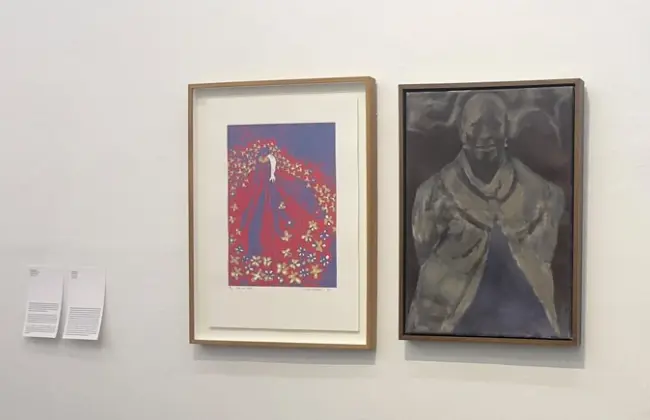
The BMW Art Generation Vol IV exhibition, Photo: Ntokozo Khumalo/EWN
Some of the pieces confront uncomfortable ideologies, positioning indigenous knowledge as a tool that enriched individuals, while also exploring how such knowledge was preserved by others.
This is seen in Kamva Matius's oil-on-canvas work depicting prominent figures.
These figures include the divisive Khotso Sethuntsa on a small oil canvas, shown smiling and painted with hauntingly dark hues.
A powerful herbalist and divine healer who allegedly gained his wealth from Paul Kruger's millions. His powers were also reportedly sought by apartheid leaders JG Strijdom and HF Verwoerd.
Also featured is the revered Sanusi Credo Vusamazulu Mutwa, painted with exaggerated proportions in a vibrant red coat and gold ornaments.
A figure believed to have predicted major world events, including the destruction of New York's World Trade Centre in 2001 and the Youth Uprising, among other events that were said to have come to pass.
The exhibition is a lesson that leaves one with many questions.
Questions that may not necessarily have answers but instead offer a new perspective on what and how we observe the world.
It challenges us to consider the lens through which we understand what we know and why we know it.
Each piece chips away at what has generally been accepted while encouraging an acknowledgement of what has been denied or overlooked in society.
Kandan shared that, for the conversations raised by the exhibition to continue, there needs to be “a willingness to sit with forms of knowledge that may not conform to Western ideas of expertise or documentation.
That requires humility, particularly from institutions, and a willingness to listen before attempting to interpret.”
“I hope audiences become curious about the histories behind what they know. We often inherit knowledge without questioning the systems that produced it. We are taught particular histories, languages and ideas about whose voices constitute authority, and those structures can become so familiar that we stop seeing them,” Kandan said.
Never miss a major story. Get breaking news and the latest developments from South Africa and beyond as they happen.