SAFA elections on the brink: SOS threatens court action as governance battle intensifies
The existence of disputes, reruns and challenges at regional level means the legitimacy of the eventual September vote could face scrutiny.

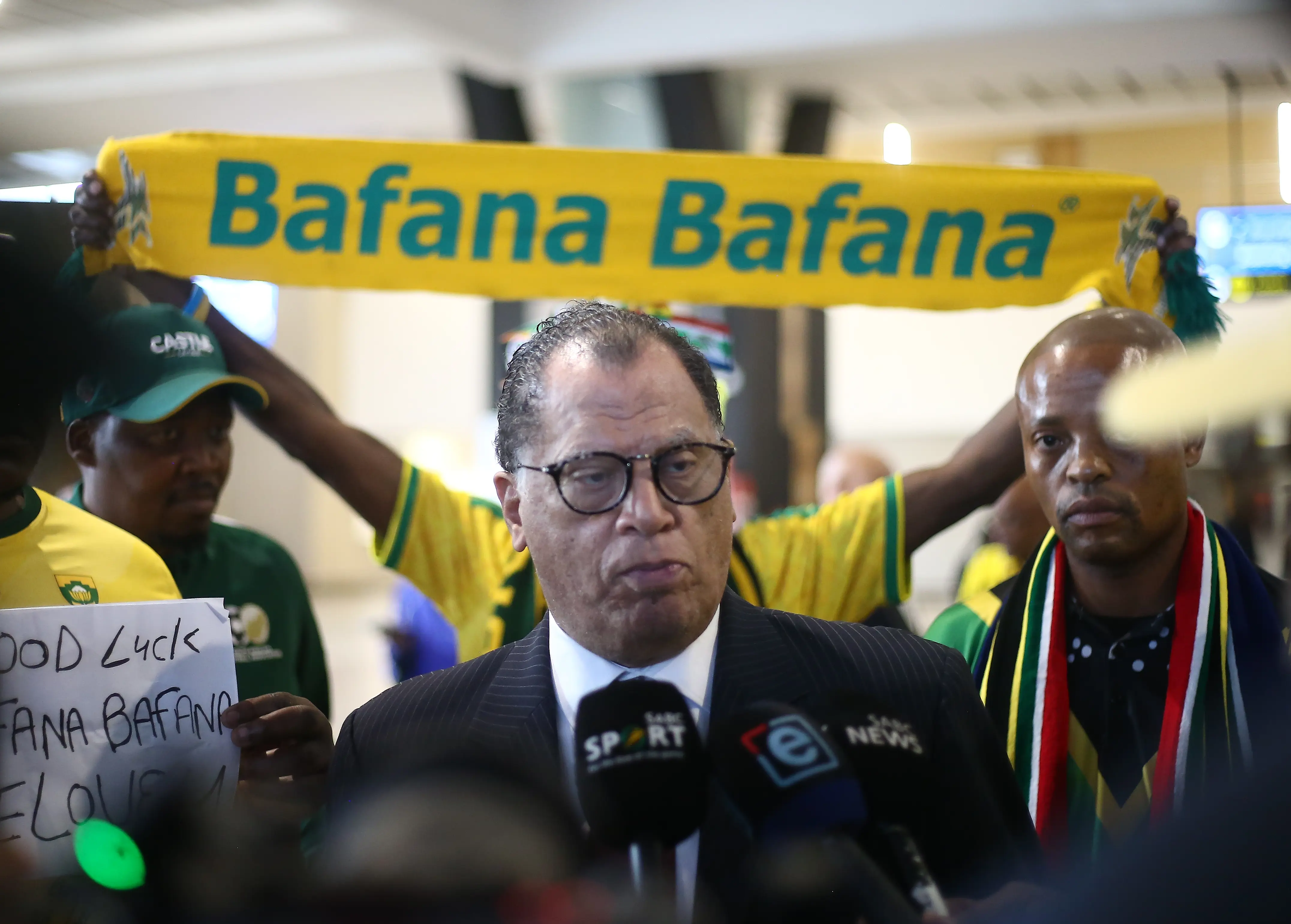
SAFA president Danny Jordaan
The allegations have not been proven, and SAFA has not publicly accepted SOS’s characterisation of the process. But the existence of disputes, reruns and challenges at regional level means the legitimacy of the eventual September vote could face scrutiny.
The NEC problem: 47 members versus FIFA’s recommendation
Running alongside the election dispute is another long-standing governance issue — the size of SAFA’s National Executive Committee.
SAFA currently has 47 NEC members, a figure that has repeatedly attracted criticism.
In 2013, FIFA recommended that SAFA reduce the size of its NEC to 18 members. Instead, SAFA’s NEC was subsequently expanded from 26 members to 47.
That has left SAFA with one of the largest football governing committees in the world.
The issue is not simply about numbers.
A larger NEC means more meetings, administration, travel and honorariums.
According to figures raised during a Parliamentary oversight engagement, NEC honorarium costs increased from approximately R2.5 million in 2023 to R6.1 million in 2024. Critics argue that the money could instead be directed towards football development and national teams.
Why has the NEC not been reduced?
This is one of the questions that has followed SAFA for years.
A proposed turnaround strategy presented last year reportedly sought to reduce the NEC to 21 members, partly because of rising costs.
But there are competing views over whether such a reduction is practical.
Football Transformation Forum chairperson Tankiso Modipa has argued that a smaller NEC would make it more difficult to provide adequate representation across South Africa’s regions.
He argues that SAFA is a geographically large organisation and that reducing the number of representatives could leave provincial and regional structures without sufficient representation.
SAFA President Danny Jordaan has also previously argued that the composition of the NEC is ultimately determined by SAFA Congress and the association’s statutes, and told a Parliamentary committee that the FIFA recommendation had previously been discussed and dismissed.
That is an important point because it helps explain why a recommendation from FIFA has not automatically resulted in a smaller NEC.
FIFA can recommend reforms, but changing SAFA’s governing structures ultimately involves SAFA’s own constitutional and Congress processes.
The unresolved question is why that reform has taken so long particularly when the recommendation dates back more than a decade.
The 21-member proposal
The 21-member proposal was therefore seen as a possible compromise.
It was presented as part of a broader turnaround strategy and was reportedly influenced by governance models being used by football associations elsewhere in Africa and internationally.
But even that proposal has run into resistance.
Modipa has argued that reducing the NEC to 21 would be practically difficult because regions need meaningful representation.
The result is that SAFA finds itself heading into an election with the same structural issue that has been debated for years.
The organisation has a 47-member NEC, while FIFA recommended 18 members more than a decade ago, and a more recent turnaround proposal suggested 21.
No final reduction has yet been implemented.
Why the NEC matters to this election
The size and composition of the NEC are particularly relevant because the current election is not simply a contest between two individuals.
It is also a contest over the future structure of South African football governance.
Jordaan’s supporters argue for continuity, regional representation and stability.
Zungu and SOS are campaigning on a reform agenda that includes stronger governance, greater transparency and changes to the way SAFA is administered. Zungu has publicly made restoring trust and integrity within SAFA central to his campaign.
That makes the size of the NEC more than a financial issue.
It is also about who has a voice, how regions are represented and how power is distributed inside SAFA.
Could the court action delay the elections?
This is where the situation becomes particularly serious.
SOS has not simply threatened to complain to another football body. It says it is preparing to approach the courts.
The group appears to be considering legal relief over the conduct of the electoral process, including the independence of electoral officers and disputed regional elections.
Whether that could actually stop or delay the 12 September elective congress would ultimately depend on what application is brought, what relief is requested and what a court decides.
It would therefore be inaccurate at this stage to say that the elections have been stopped.
But a successful urgent court application could potentially have significant consequences for the electoral timetable.
The possibility of litigation also raises the prospect that SAFA could enter its elective congress with unresolved legal disputes hanging over the legitimacy of some delegates or regional structures.
A credibility test for SAFA
The stakes are therefore much bigger than the battle between Danny Jordaan and Sandile Zungu.
The election has become a test of whether SAFA can demonstrate that its electoral processes are transparent, impartial, consistent and compliant with its own statutes.
SOS says it has already approached FIFA, CAF and SASCOC without getting the intervention it wants.
SAFA, meanwhile, has not accepted the allegations, and some individuals accused by SOS have dismissed them as propaganda.
That leaves the courts as the next potential battleground.
With regional elections still generating disputes, allegations of intimidation and bullying being aired, questions over electoral-officer independence, concerns about compliance and the long-running controversy over SAFA’s oversized NEC, the 12 September election could become one of the most consequential in the association’s recent history.
And if SOS follows through with its threat to approach the courts, the battle for the future of South African football may move from the boardroom to the courtroom.
Article by Mbali Mokoko