Minister promises big changes in electricity pricing, but analyst questions implementation
Electricity Minister Kgosientsho Ramokgopa has revealed more detail about government's revised pricing policy, but Chris Yelland asks how he's going to fund an increase in free basic electricity.

Electricity and Energy Minister Kgosientsho Ramokgopa briefs the media on SA’s Revised Electricity Pricing Policy, 18 August 2026. Facebook/Department of Electricity and Energy
Electricity and Energy Minister Kgosientsho Ramokgopa has revealed more detail about South Africa's Revised Electricity Pricing Policy (EPP), which was approved for public comment last month and is due to be gazetted on Friday.
Government says strengthening the regulatory framework is meant to provide tariff transparency through the unbundling of tariffs across generation, transmission, distribution and retail activities.
The measures supports the introduction of cost-reflective tariffs while protecting vulnerable users and strategic economic sectors.
RELATED: New electricity pricing rules promise greater transparency for users to see where their money goes
Addressing a media briefing on Tuesday, Minister Ramokgopa emphasized the proposal to increase the monthly free basic electricity (FBE) allowance for indigent households from 50 kilowatt-hours to 200-300 kWh.
He said the policy aims to establish a tariff path that will provide some certainty on the cost of power over the next 10 years.
What there isn't certainty about, however, is how the draft EPP is actually going to be implemented, remarks energy analyst Chris Yelland, MD of EE Business Intelligence.
"The aspirations detailed today were all in the existing policy. And the media briefing was very disjointed as we could only could watch partially on SABC. We haven't seen the official document yet, but from what I heard, I didn't see much new."
The EPP contains a lot of aspirational policy messaging, which is fine in a policy document, Yelland says. But he questions how that is going to be translated on the ground and how it will affect the prices we pay.
"Yes, I do think there is room for a further unbundling and clarity in municipal tariffs. But Eskom tariffs are pretty much unbundled and we can see how it's made up. But that doesn't change the price - it just separates the price into different components."
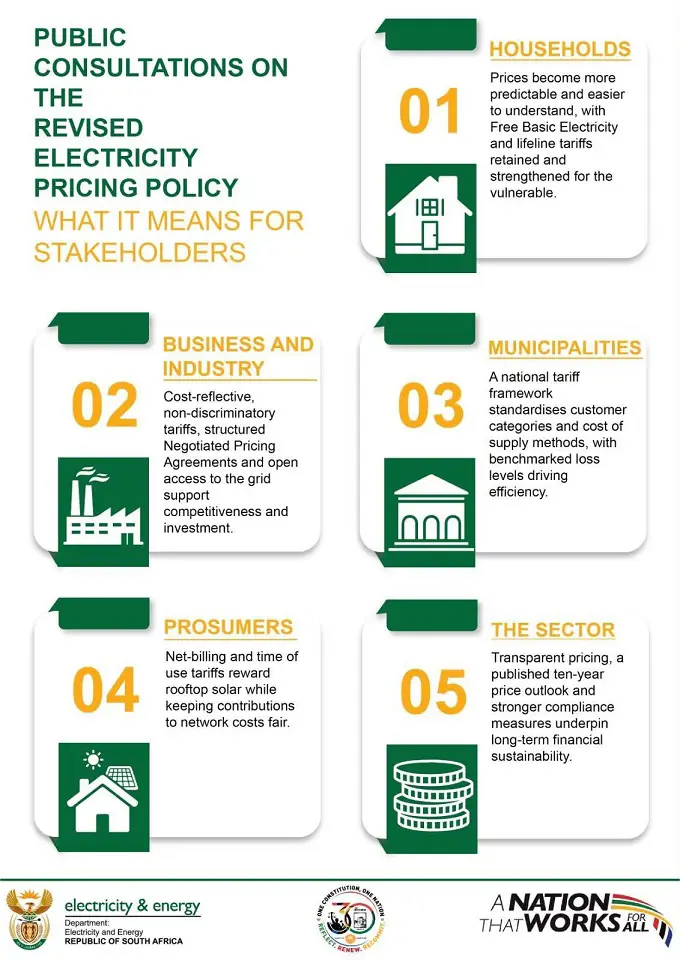
Public consultations on Revised Electricity Pricing Policy -Department of Electricity and Energy
Yelland further questions how government is going to fund an increase in free basic electricity.
"The Minister talks about increasing the number of people who receive this by a factor of five, because at the moment only 20% of qualifying households receive their free basic electricity allocation and he's got some mechanisms he says would extend this to all qualifying people."
For this there is money allocated by National Treasury, he notes.
However, increasing the kilowatt-hours means this allocation would have to be increased five times, according to Yelland.
"And if it's not going to come from from Treasury, where is it going to come from? Presumably from the customers that do pay... so free basic electricity is not then going to be a separated funding mechanism that is transparent. It will be built into the price of electricity."
For more insight from Chris Yelland, listen to the interview audio at the top of the article