Continuing job losses drive official SA unemployment rate to 33,6%
Manufacturing is one of the key sectors hit by a drop in jobs, according to the Q2 numbers from Stats SA.

Unemployed men at the side of the road in Zwelihle, Hermanus, unemployment. 123rf.com/© petertt
South Africa's official unemployment rate rose in the second quarter of 2026 to 33,6%.
That's an increase of 0,9 of a percentage point from 32,7% in the first quarter of the year.
The number of unemployed persons grew by 345 000 to 8,5 million, according to Statistics SA's latest Quarterly Labour Force Survey, or QLFS. (Click here for the key findings)
In terms of the expanded definition, the unemployment rate in the second quarter jumped to 13.1 million people - 43.8% of the working age population. This figure includes discouraged jobseekers and adults who should be able to work.
A drop in jobs was recorded mainly in the community & social services, mining, agriculture and manufacturing industries.
And given the latest manufacturing statistics, South Africa is also now entering quite a pedestrian quarter of growth, says Momentum group economist Sanisha Packirisamy.
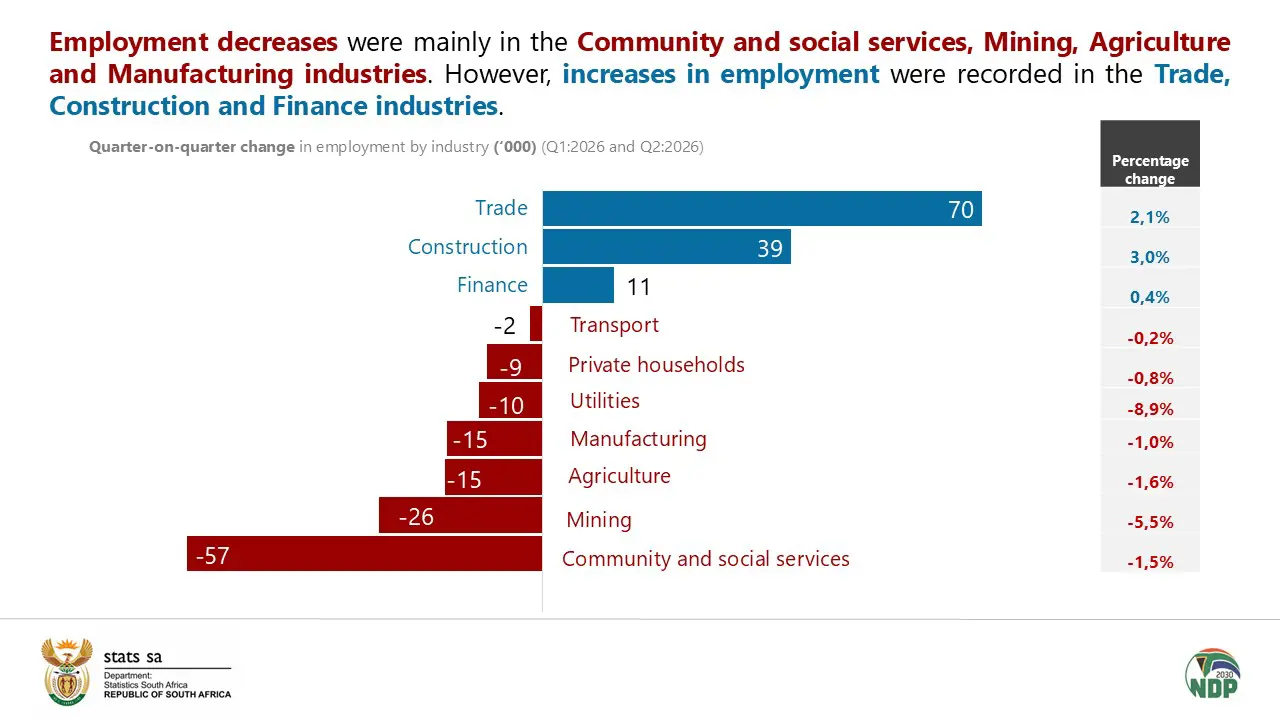
Employment decreases and increases for Q2:2026, Stats SA
On the employment side, we need to remember that jobs are a bit of a lagging indicator of economic activity, so given our pedestrian growth rate over the past while, this will lead into quite weak job numbers, she explains.
"We get quite a lot of data from Statistics SA in terms of where jobs are being created and where they're being destroyed, and there are a couple of signals suggesting that some of that unemployment or employment weakness is relatively in line with your economy, so cyclical in nature."
To see manufacturing and unemployment more broadly, recover on a more sustainable basis, a number of factors are involved, Packirisamy says.
She whittles these down to the need to increase demand, improve infrastructure and raise competitiveness.
Demand levels are of course also tied to domestic and external factors, like supply issues related to Strait of Hormuz closures which dampened economic activity globally.
"With infrastructure, we need to see business confidence picking up in a sustainable fashion in order for private fixed investment to come on stream in a more meaningful way. "
Referring to structural reforms in South Africa, she makes the point that some of the improvements we have seen, like for instance with electricity, will actually have a more meaningful impact on economic growth rates further down the line.
"We've seen quite a bit on the electricity front, especially with generation. What we still need to see is an improvement on transmission as well as distribution."
RELATED: Eskom chair denies standoff with Presidency over unbundling process
Scroll up to the audio player to hear Packirisamy's analysis