Interest rate hike looms as Middle East conflict, fuel prices drive inflation to 5%
The higher-than-expected CPI print for June points to a likely rate increase announcement this week.
An inflation warning sign as rising fuel prices and higher living costs continue to put pressure on South African households. Picture: jjvallee/123rf.com
Consumer price inflation (CPI) jumped to 5% in June, driven by an increase in transport costs that were underpinned by higher fuel prices.
This is a 0,5% increase from 4,5% in May.
The inflation print comes ahead of the South African Reserve Bank (SARB) interest rate decision on Thursday, seemingly cementing the case for a hike as the renewed conflict in the Middle East pushes up oil prices.
RELATED: Can we expect rate hike this week as intensifying Middle East conflict fuels oil prices?
Statistics SA said it is the highest inflation print since June 2024 when the rate was 5,1%.
Prices rose by 0,7% on average between May and June, the same increase recorded between April and May.
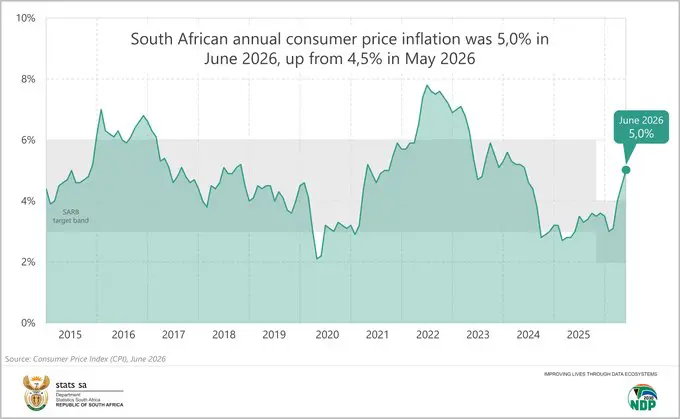
CPI June 2026 - Stats SA
Transport was the largest contributor to both the annual and monthly changes in the CPI for June.
Higher fuel prices had a knock-on effect on passenger transport inflation, which registered a monthly rise of 8,1%.
There was some respite for consumers with food inflation continuing to edge lower, says Stats SA.
Annual inflation for food and non-alcoholic beverages (NAB) dipped to 1,6% in June from 1,9% in May and 2,9% in April.
Several notable products are cheaper than a year ago, including white rice (-13,4%), maize meal (-5,9%), samp (-1,5%) and porridge (-1,3%).
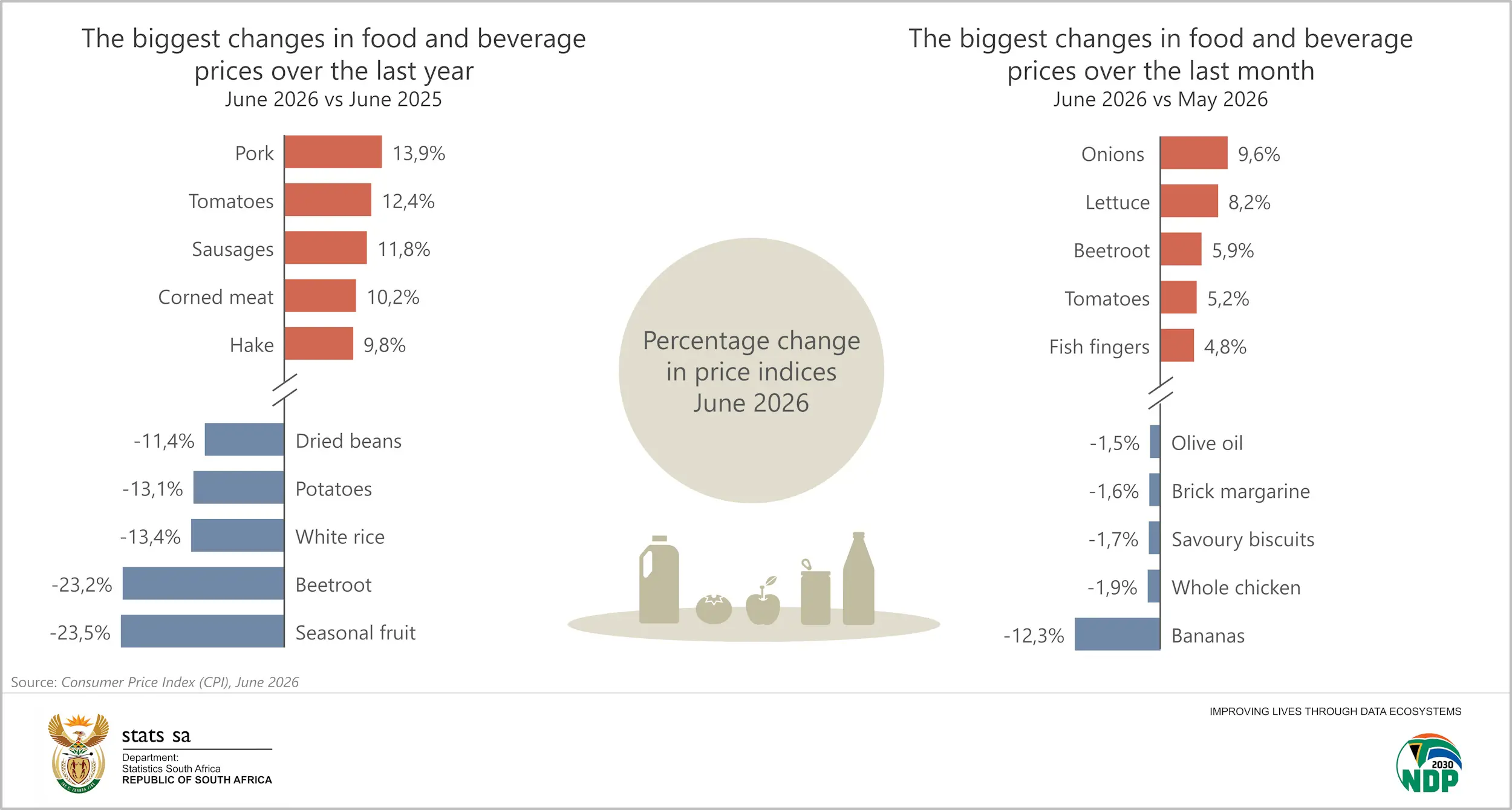
Food inflation June 2026 - Stats SA/X
Inflation of 5% was a bit worse than what the markets were even looking for, remarks Sanisha Packirisamy, chief economist at Momentum Investments.
"Investors were expecting an acceleration in inflation, but only to about 4.7-4.8% in year-on-year terms... and it came out at 5%."
What is going to be particularly concerning for the central bank's deliberations on monetary policy is the rise in underlying inflationary pressures or core measures, she says.
"These measures, that basically strip out your more volatile components like food and fuel, have gone up in this monthly print from 3.8% to 4.1% in YoY terms,... Another concern is services inflation that actually rose from 4.7% to 5.2%."
Packirisamy's forecast for the looming rate decision is that the SARB will split what some economists are now predicting will be a 50-basis-point increase, into two incremental hikes of 25 basis points each.
Scroll up to the audio player to listen to Packirisamy's analysis