Welcome fuel price relief with big cuts confirmed for 1 July
Fuel prices are finally coming down this week, the Department of Mineral and Petroleum Resources has announced.

Fuel, petrol station. 123rf.com/bizoon
South Africans will see welcome fuel price relief as we enter July, with prices set to drop across the board on Wednesday.
The Department of Mineral and Petroleum Resources announced the official adjustments for July 2026, which followed a drop in oil prices because of the (on-again, off-again) ceasefire agreement finally reached by the US and Iran.
RELATED:
- Fuel prices expected to fall sharply in July, but don't count your chickens just yet
- Consumer confidence plummets in wake of fuel price shock
The price of petrol goes down by around R2 a litre, while the cut for diesel is over R3.
Illuminating paraffin benefits the most, with the price falling by over R5 a litre.
Stephen Grootes talks to RMB chief economist Isaah Mhlanga, and asks whether this welcome development relating to fuel is any reason for optimism around interest rates.
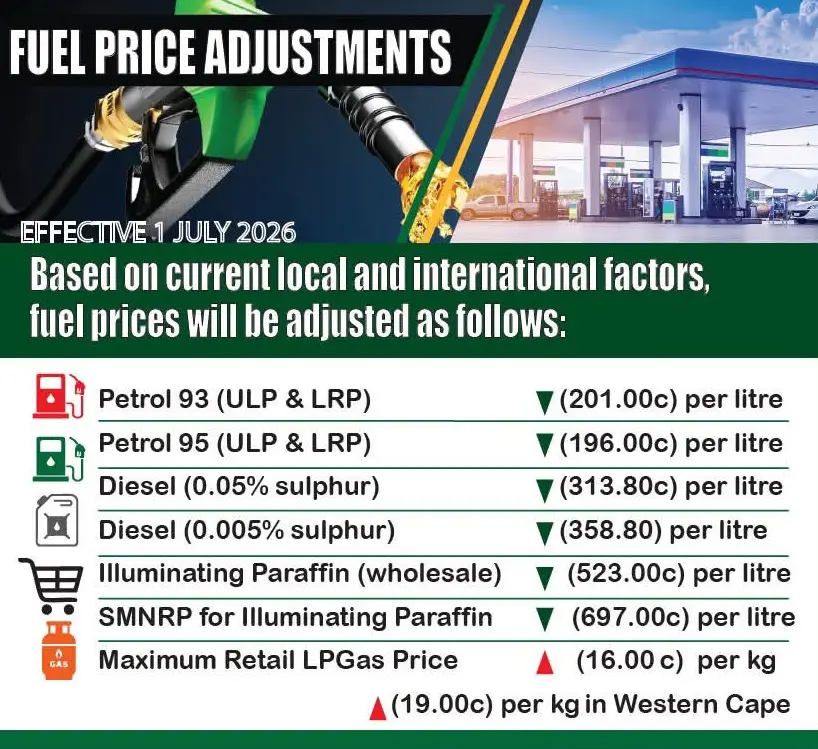
Fuel price adjustments, 1 July 2026. Department of Mineral Resources and Energy/Facebook
Mhlanga cautions that inflation, overall, is still expected to remain relatively high for the next two or three months on a year-on-year basis.
"Remember that we always compare the prices this month relative to the same month in the previous year, and that base is still quite low relative to where we are now."
And while going into their July meeting with a significantly lower fuel price forecast could tilt the scale towards the SARB's Monetary Policy Committee (MPC) holding interest rates, another hike could also be expected, Mhlanga says.
"The target for inflation is 3%... The May rate was 4.5%, which means 1.5 percentage points above the target band. We can also still expect some pass-through effects to be in the system, which would imply we might even see headline inflation rising slightly above 4.5% before it peaks and starts to come down."
Scroll up to the audio player to listen to Mhlanga's analysis