Residents accuse Kleinfontein leaders of running settlement like a 'criminal enterprise'
Factional divisions have intensified at the whites-only enclave of Kleinfontein, with some residents accusing their leaders of running the settlement like a 'criminal enterprise'.

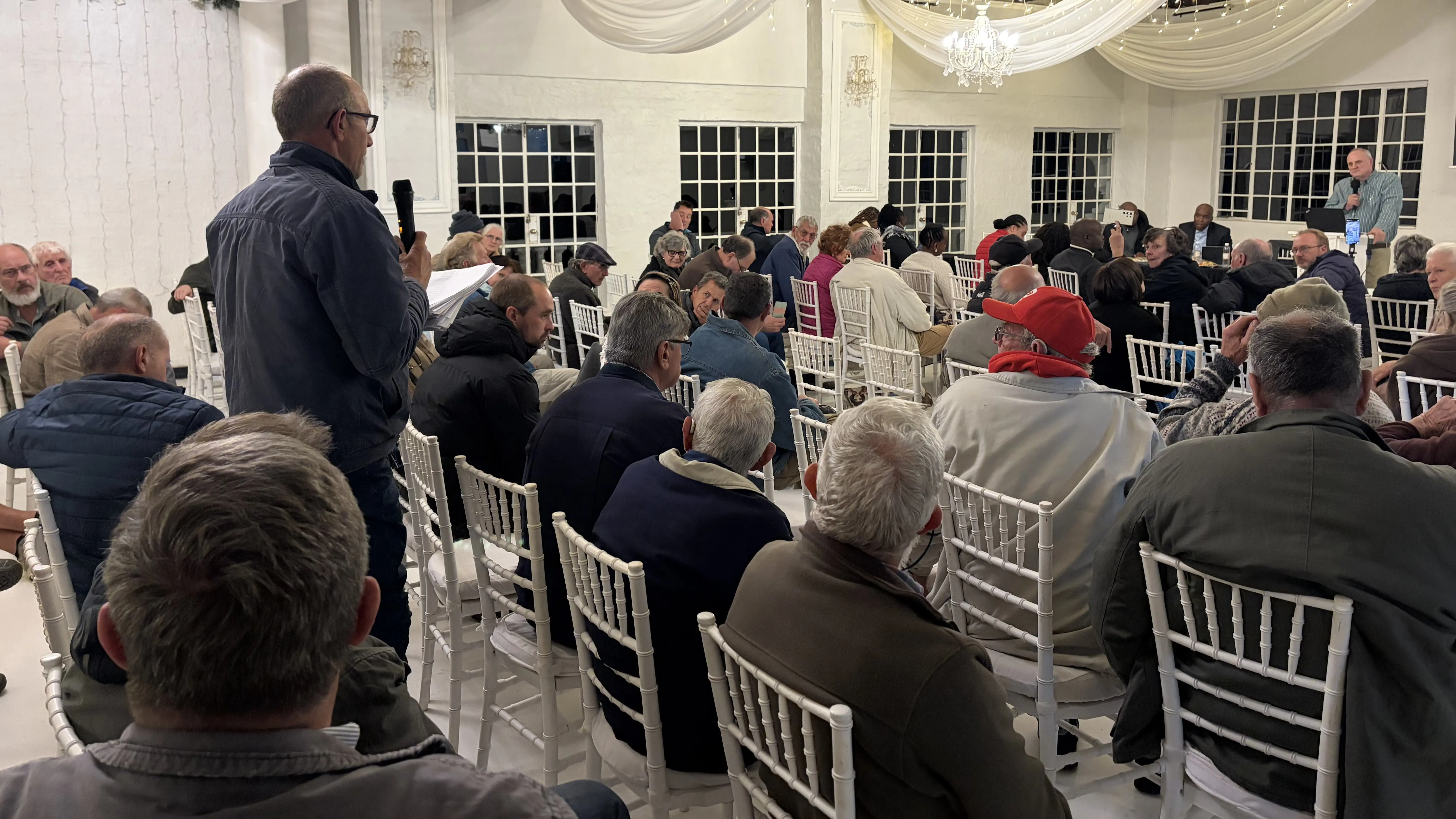
A group of Kleinfontein residents held a community meeting with Tshwane Municipality’s political leadership at the Casablanca Manor Wedding Venue in Pretoria. Picture: Thabiso Goba/EWN
Factional divisions have intensified at the whites-only enclave of Kleinfontein, with some residents accusing their leaders of running the settlement like a “criminal enterprise”.
Some residents also want out of the settlement’s governance system and want to pay their municipal bills directly to the Tshwane Municipality.
ALSO READ:
Kleinfontein fights: Residents seek to bypass board and pay rates directly to Tshwane
Small group of Kleinfontein residents refusing to pay levies to board of directors
Kleinfontein’s board of directors have acknowledged the frustration from some of their residents, saying they are working to fix the issues.
EWN recently attended a heated community meeting, which featured about a hundred residents from Kleinfontein, a majority of them who are disgruntled with the conditions at the settlement.
KLEINFONTEIN, AN ILLEGAL TOWNSHIP
Nestled in the farm belt of Pretoria east, Kleinfontein is also known as ‘mini-Orania’.
Just like Orania, the only people who live in Kleinfontein are white Afrikaaners.
It was established in 1992, largely over fears that Afrikaaner identity would be eroded in the new democratic South Africa.
The 900-hectare settlement is made up of several farms bought over a period of time.
It was initially zoned as “agricultural”; however, the building of residential homes created an awkward situation with the Tshwane Municipality.
The Kleinfontein board of directors said they had been trying for a number of years, without success, to formalise the area to be officially recognised as a township.
They said political instability in the Tshwane Municipality, the constant changing of administrations and legislation have frustrated the process.
In 2024, Kleinfontein was officially designated as an “illegal township” through an order by the Gauteng High Court.
Ironically, the court challenge was brought forward by four Kleinfontein residents who were frustrated with the running of the settlement.
KLEINFONTEIN, A CRIMINAL ENTERPRISE
Hendrik Celliers, 73, is listed as the first respondent of 2024 Gauteng High Court judgment.
He has lived in Kleinfontein for over two decades and said he is tired of the excuses by the settlement’s board of directors for their failure to properly formalise the area.
“Kleinfontein is a criminal enterprise because the court said it’s a criminal enterprise. Kleinfontein is run by a cartel, and we are not allowed to speak on Kleinfontein. It’s like North Korea,” he said.
On Friday night, Celliers was part of a community meeting attended by about a hundred Kleinfontein residents.
The meeting was held at an outside wedding venue in Bronkhorstspruit.
Several people who organised the meeting said the leaders of Kleinfontein refused to allow the community hall in the settlement to be used for the meeting.
The leadership of Kleinfontein told EWN that they were against the meeting because it was premature, since they are very close to reaching a settlement agreement with the City of Tshwane for formalisation.
The meeting was attended by Republican Conference of Tshwane councillor Lex Middelberg, Aaron Maluleka, Tshwane’s MMC for Human Settlement, and Eugene Modise, Tshwane’s Deputy Mayor and Finance MMC.
Celliers, who has been accused of leading an “informal pressure group” within Kleinfontein, said he was happy with the turnout of the meeting, despite attempts by the leaders to kill it.
In addition to the court challenge, Celliers has also led a rates revolt in Kleinfontein, wanting to pay them directly to the municipality instead of the settlement’s board.
He said for many years, the leadership at Kleinfontein blamed the Tshwane Municipality for the failure to formalise; however, he said the blame lies closer to home.
“It’s very clear tonight, the problem is not with the municipality, it’s with the people that’s in control of Kleinfontein - they don’t want to get legal,” he said.
“Because the moment they become legal, they can’t carry on with their criminal enterprise. They intimidate the old people; they buy up their properties for half of the price and who buys it? The people on the board.”
A majority of the people in Kleinfontein are old and at pension age.
Celliers said many of them are worried about their properties and future with the settlement illegal status and it reportedly owing millions to the Tshwane Municipality.
“I am running these court cases on behalf of the old people and those that don’t have a voice because I can’t be intimidated,” he said.
Picture: Thabiso Goba/EWN
KLEINFONTEIN SHAREBLOCK PROPERTY SCHEME
Kleinfontein sits on 900-hectares of land, which is entirely owned by a holding company.
That company is managed by Kleinfontein’s board of directors.
Kleinfontein operates an alternative form of property ownership called a ‘share block scheme’.
Prospective residents purchase shares from the holding company and, in return, are granted a portion of surveyed land, which they can use to build a house and make improvements.
Instead of a traditional title deed, residents are shareowners of the holding company.
In 2015, Warren Holtzhausen bought 90 shares at R1,000 a share, which granted a plot of land to build his property in Kleinfontein.
Holtzhausen said he was aware he signed onto a share block property ownership scheme; however, he claims he was promised sectional title deeds after the settlement was formalised.
“I want ownership of my property; I bought that property with money. I paid for the ground, I developed that ground,” he said.
Holtzhausen said the shares he has are worth the paper they are written on.
Holtzhausen said he once went to one of the country’s biggest commercial banks to try borrowing against his shares and was rejected.
“I have got a piece of paper that says I have got a share. That share certificate, we have found out doesn’t mean anything,” he said.
“When I bought them, they said my shares are a R1,000 per share. Two, three years ago, they turn around said now its R1. So, what is my share certificate actually worth?”
Holtzhausen said he wants to remain in Kleinfontein, as the reason he joined the whites-Afrikaner-only settlement is still valid; however, he wants to own his home.
He said he feels duped by the Kleinfontein leaders.
“When we sat in a meeting, we were told this is the property, we are busy with formalisation. I bought here in 2015. It will be done in two months’ time - that was told to me by Jan Groenewald [one of Kleinfontein’s founding fathers],” said Holtzhausen.
Willie Liebernberg, a Kleinfontein resident, said he doesn’t have a side in the whole debate.
Lieberberg said he attended the Friday night community meeting to get more information from the Tshwane Municipality officials.
“The only thing I want to see is the people being treated fair and the title deeds are going to be given to the people that got legal ownership of the property they bought,” he said.
Liebenberg said he rents a property in Kleinfontein; however, he’s still concerned about the issues raised by his fellow community members.
“Kleinfontein is a very nice place to stay in. I have no problem with the place as is, but there are many old people who have invested their last money into the place and if there must be a demolishment to happen in Kleinfontein, what’s going to happen to those old people?”
KLEINFONTEIN’S R22-MILLION HEADACHE
In the 2024 Gauteng High Court ruling, the Tshwane Municipality was ordered to enforce the law in Kleinfontein by ensuring the settlement is properly rezoned.
Since then, the municipality has established a task team, which is tasked with formalising 17 illegal townships in the capital, which also includes Kleinfontein.
Maluleka said it was important to make the task team non-political so that it would stay in place even if there is a change in the political administration after the local government elections in November.
In the three-hour community meeting, Maluleka told the Kleinfontein residents that this was not an election campaign gimmick, but part of his official duties to engage all residents in the city.
“I doubt any of you here vote for the ANC [African National Congress], we don’t have a constituency here,” said the ANC councillor to much laughter in the crowd.
Maluleka said he is aware of the factional divisions within Kleinfontein, saying his presence was not an endorsement of one over the other.
“We owed the people of Kleinfontein this engagement. It would have been unfair for us not to come here,” he said.
“We are happy there was a response from the community who came to listen to us and raise their views. We have solicited very interesting points on how we can assist them. Parallel to this process there are litigations, but we don’t believe those should hinder us from engaging the community.”
‘We are not perfect’ – Kleinfontein chairperson
“Look, we are not perfect by any stretch of the imagination and there is definitely much we can improve on,” said Rian Genis, Kleinfontein’s elected Chairperson.
Genis attended the Friday night community meeting and was jeered by the crowd when he stood up to speak.
He said the frustration is understandable, however his focus is now on securing a formalisation agreement with the Tshwane municipality.
Genis said the agreement is close, that’s why the Kleinfontein leadership did not want the meeting to be held at its community hall.
“We wanted the opportunity for the litigation to be settled, to be finalised first. They said we acted negatively, no, we were advised lets settle the litigation first and we would be happy to participate,” he said.
Genis also defended Kleinfontein’s share block scheme, saying it was clearly explained to all residents prior to them buying the shares.
“Many of the commercial banks are not comfortable with a share block company as such (but) there are financial institutions that are very comfortable to borrow with that,” he said.
Genis denied Kleinfontein owes the Tshwane municipality R22-million, saying that figure is still subject to ongoing litigation.