SAns underestimate their salt intake: How much sodium does your body really need?
Almost all populations are consuming too much sodium, says the World Health Organization, and South Africa is no exception.

Image of table salt: Pixabay
South Africa has one one of the highest salt intakes in the world and no wonder, considering our love of biltong, boerewors and a traditional braai.
That is why, during World Salt Awareness Week, the Heart and Stroke Foundation of SA (HSFSA) has been running "The Salt Shift" campaign to protect cardiovascular health.
It wants to raise awareness about potassium salt substitutes, a lesser-known option for managing blood pressure, a common symptom of high salt intake.
Research has established a clear link between high salt intake and an increased risk of elevated blood pressure. And South Africans underestimate their salt intake, the Foundation says.
"Over one in three people are walking around with high blood pressure... yet when asked about their diets, the majority self-reported normal salt consumption."
RELATED:
Hidden sources of salt like bread, processed meats and ready meals can increase sodium levels without us even realising it, the Fountain points out..
Dr Fundile Nyati explains that the chemical name of common table salt is sodium chloride, made up of 40% sodium and 60% chloride.
"The body does not produce sodium, so we need to take it in on a daily basis."
This means that, as much as a high intake of sodium is bad for us, so is an intake that is too low, says the doc.
Sodium is an essential nutrient necessary for the maintenance of plasma volume, acid-base balance, transmission of nerve impulses and normal cell function.
While sodium deficiency is extremely unlikely in healthy individuals,an excess is linked to adverse health outcomes, including increased blood pressure.
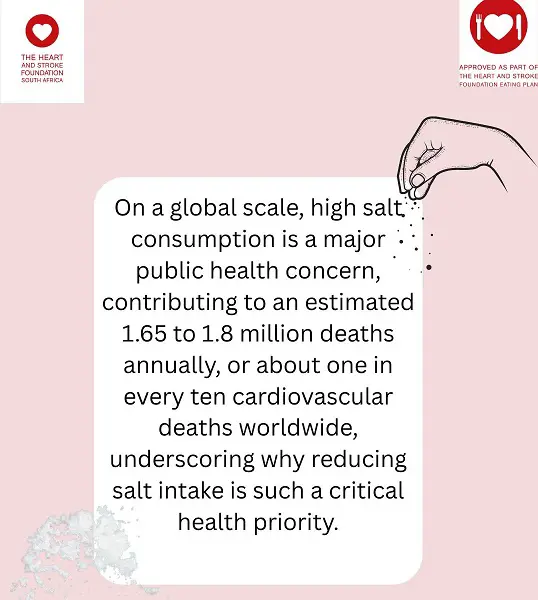
Salt consumption warning - Heart and Stroke Foundation South Africa on Facebook
For adults, the World Health Organization (WHO) recommends less than 2 000 milligrams a day of sodium (just under a teaspoon), which is equivalent to less than 5 grams a day of salt.
When it comes to reducing sodium intake, the WHO suggests replacing regular table salt with lower-sodium salt substitutes that contain potassium.
Responding to a listener's question about the huge variety of salts we now see on shelves, Dr Nyathi recommends sticking largely to the iodised table salt which was introduced some years ago to ensure optimal thyroid function for South Africans.
Another listener asks whether that staple product, Aromat, can be used as an alternative to salt.
Dr Nyathi points out that the original seasoning was very high in sodium, but that Unilever brought out a healthier "naturally tasty" version that contains 40% less sodium per gram than regular salt.
To listen to Dr Fundile Nyati in conversation with Gugs Mhlungu on 702's Weekend Breakfast, click on the audio link below: